
Illustration
Gutter installation, repair and guards in Milwaukee, WI
Milwaukee gutters built for cloudbursts and ice
New seamless gutters, repairs, guards and downspouts across Milwaukee, Wauwatosa, West Allis, the North Shore and Waukesha County. Call and you are connected with an independent local contractor.
Services
What can you call about?
Anything that moves water off your roof and away from the house. That covers new seamless gutters, repairs to leaks, sags and storm damage, gutter guards, downspouts, cleaning and the fascia and soffit the gutters hang from. One call to
puts you through to an independent contractor who works where you live.A gutter system is more parts than most people expect. Water leaves the shingles over the drip edge, lands in the trough, travels along a run pitched toward an outlet, drops through an elbow into the downspout, and leaves at a splash block or extension. Each of those parts can fail on its own, and a good contractor checks all of them, not only the piece you called about.
| Work | What it usually involves |
|---|---|
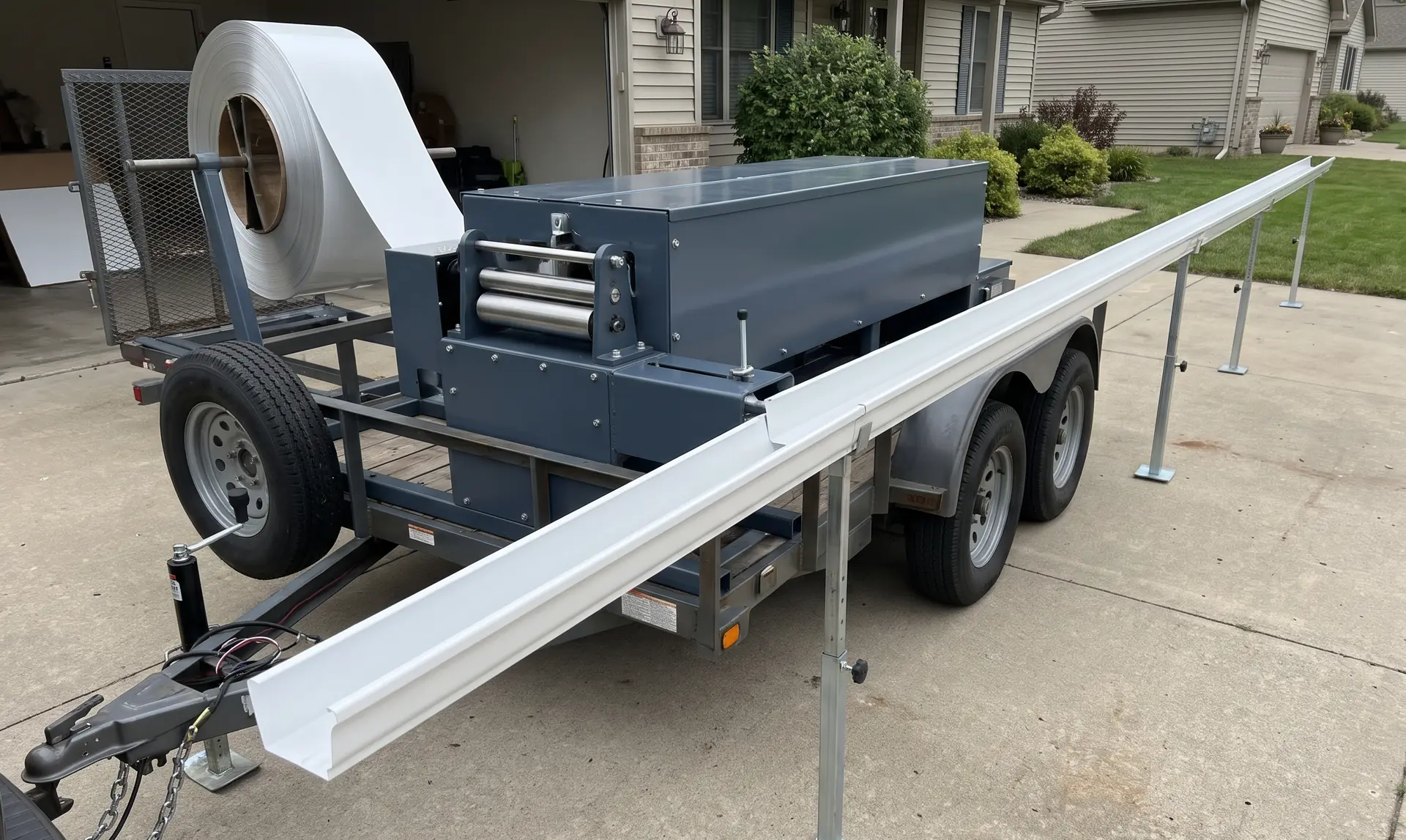
| Installation | Seamless aluminum formed on site, hidden hangers, new downspouts |
| Repair | Resealing corners, re-pitching, re-hanging, patching seams |
| Replacement | Taking down old runs, fixing fascia, hanging new |
| Guards | Micro-mesh or covers sized to local leaf and seed fall |
| Cleaning | Clearing troughs and downspouts, flushing, checking pitch |
| Commercial | Box gutters, scuppers, collector heads on larger roofs |
Local conditions
Why do gutters work harder in Milwaukee?
Because they handle two kinds of punishment a year: summer downpours and a winter of snow and ice. Milwaukee averages 34.57 inches of precipitation a year, with June the wettest month at 4.38 inches, and 48.7 inches of snow in a normal season, most of it from December through February.
The downpours set the size of the gutter. NOAA's Atlas 14 estimates for central Milwaukee put a 10-year storm at 6.95 inches an hour over five minutes, the short, hard burst that decides whether water stays in the trough or sheets over the front edge. That figure feeds the standard method for sizing gutters, and on a typical roof it is the difference between 5-inch and 6-inch.
The winters decide how the gutter is fastened. Snow sliding off a roof, ice forming in the trough and icicles hanging off the lip all add weight that rain never does. Hangers spaced too far apart, spikes driven into old fascia, and thin .027-inch aluminum are what pull loose by March.
Then there is the worst case. On August 9 and 10, 2025, a gauge on Milwaukee's northwest side recorded 14.55 inches of rain, a new Wisconsin record, and the airport's 5.74 inches on the Saturday was the second-highest single day on its books. No gutter is built for that, but downspouts that carry water well away from the foundation make a real difference to what reaches the basement.
Cost
How much do new gutters cost?
Expect most whole-house jobs to be priced per running foot, with downspouts, corners and repairs on top. Use the slider for a ballpark from national price ranges, then get a written quote from the contractor who measures your house.
A brick bungalow in Washington Heights or Bay View often has 100 to 150 feet of gutter. A two-storey house or a duplex with a detached garage can run 180 to 260. Second-storey work, steep pitches and fascia that has to be replaced first all add to it.
The Milwaukee gutter cost guide explains what moves a quote up or down, and what a fair quote should list.
Rough price for your house
$1,440 to $2,240
A guide only, built from current national price ranges (Angi aluminum gutter cost guide, This Old House seamless gutter cost guide). Corners, downspouts, fascia repairs and access change the figure. Call and a local contractor will measure and quote the real one.
How it works
What happens when you call?
- You call and say what is wrong and where the house is. A neighborhood or cross street is enough to start.
- You are connected with an independent gutter contractor who works in that area.
- They arrange a visit, look at the gutters, fascia, roof edge and downspouts, and measure.
- You get their written quote, which should state size, material, gauge, hanger type and spacing, downspout sizes and where each one will discharge.
- You decide. The agreement is between you and the contractor. Nothing is booked until you say yes.
Diagnose
What is your gutter telling you?
Most gutter trouble shows itself from the ground. Match what you see to the likely cause before you call, and you will have a better conversation with the contractor.
A sheet of water spills off the front lip in a cloudburst
First suspect the outlet. Maple seeds, ash leaflets and roof grit pack into the drop and the gutter fills like a bathtub. If the outlet is clear and it still spills, the run may have lost its pitch, or the gutter is simply too small for the roof above it. Clearing, re-pitching or stepping up to a 6-inch trough are the usual fixes. See 6-inch gutters.
Water drips from an inside or outside corner
Corners and end caps are where a seamless gutter is joined, so they are where sealant fails first. Freeze-thaw cycles open the joint a little more every winter. A proper repair scrapes the old sealant off, cleans to bare metal, rivets if needed and reseals. See leaking gutters.
The run bows down between hangers or leans off the fascia
Ice and packed snow load a gutter far beyond its rain weight, and spikes back out of the wood. If the fascia board is soft behind them, the fastener has nothing to bite. Re-hanging on screw-in hidden hangers, or replacing the fascia first, is the fix. See sagging gutters and fascia and soffit.
Icicles and a ridge of ice along the eave
That is an ice dam. Warm air leaking into the attic melts snow on the roof, the water runs down and freezes again over the cold overhang and in the gutter. Gutters do not cause it, but they carry its weight. A contractor can repair bent hangers and seams, and the attic side is worth a look by an insulation or roofing specialist. See ice dams and gutters.
Dents, cracked seams or a crushed downspout after a storm
Shallow hail dimples are mostly cosmetic. Dents that hold water, split seams, a gutter pulled off by a falling limb and flattened downspouts change how the system drains and are worth having looked at. Photograph it before anything is moved. See hail and storm damage.
A wet basement wall or a puddle at the foundation
Check where each downspout ends. Water dropped beside the wall soaks down along the foundation, and the region's clay subsoils drain slowly. An extension that carries water several feet out to ground sloping away, or a re-routed downspout, usually helps. In parts of Milwaukee and Shorewood, downspouts that still run into the sewer may also have to be disconnected. See downspout repair.
Old houses, new houses
Which houses have which problems?
The city's housing is old: about a third of Milwaukee's homes were built in 1939 or earlier. Those houses, including the Polish flats of the south side and Riverwest, often have original fascia and rafter tails behind the gutter, built-in or box gutters hidden in the cornice, and downspouts that still drop into a standpipe. Repairs there often start with the wood.
Postwar ranches and capes in places like Brown Deer or Greenfield usually have simpler eaves and a second round of gutters that is now reaching the end of its life. Newer homes in Franklin, Mequon and Germantown tend to have larger, steeper roofs with valleys that justify 6-inch gutters.
Trees
Which trees fill gutters around Milwaukee?
Maples, oaks, lindens and ash are the usual culprits. Maple seeds pack outlets in late spring, oak and maple leaves bury the trough in October and November, and lindens drop flowers and bracts in summer. Ash is a special case: emerald ash borer was confirmed in Milwaukee in 2012 and kills ash within two to four years, so dying ash trees shed twigs and limbs onto roofs while they wait to be removed. Milwaukee County Parks alone has removed more than 25,000 trees since then.
If you clean more than twice a year, gutter guards are worth pricing. Fine micro-mesh handles maple seeds and small debris best. The guide to guards covers what each type does with snow and ice too.
Areas
Where in the Milwaukee area can you call from?
Milwaukee neighborhoods, the North Shore, the western and southern suburbs, and the Waukesha County communities around them. Each area page covers what tends to go wrong with gutters there.
- Bay View
- Riverwest
- East Side
- Washington Heights
- Sherman Park
- Lincoln Village
- Walker's Point
- Wauwatosa
- West Allis
- Greenfield
- Brookfield
- Elm Grove
- New Berlin
- Waukesha
- Muskego
- Menomonee Falls
- Germantown
- Shorewood
- Whitefish Bay
- Fox Point
- Glendale
- Brown Deer
- Mequon
- St. Francis
- Cudahy
- South Milwaukee
- Oak Creek
- Franklin
- Greendale
- Hales Corners
No page for that area yet. Call and say where you are.
Checking a contractor
How do you check who you hire?
Ask for a written quote, a certificate of liability insurance and the warranty terms on paper, and check any permit is pulled by a certified business. Wisconsin has no gutter licence of its own, but its home improvement rules give you rights worth knowing.
Terms
What do the words on a quote mean?
| Term | What it means |
|---|---|
| K-style | The common gutter with a flat back and decorative front |
| Half-round | A semicircular trough, common on older and historic houses |
| .027 / .032 | Aluminum thickness in inches; .032 is stiffer under ice |
| Hidden hanger | A bracket inside the gutter, screwed into the fascia |
| Outlet (drop) | The hole in the gutter bottom that feeds the downspout |
| 2x3 / 3x4 | Rectangular downspout sizes in inches |
| Miter | A corner joint, sealed, and the most common leak point |
| Drip edge | Metal flashing that guides water off the shingles into the gutter |
Questions Milwaukee homeowners ask
What do new gutters cost in Milwaukee?
Gutters are priced by the running foot. National price guides put seamless aluminum at roughly $9 to $14 a foot installed for 5-inch and $11 to $17 for 6-inch, with steel and copper higher. Length, height, corners, downspouts and any fascia repair move the figure. The contractor measures the house and gives you a written quote of their own.
Who does the work?
An independent local gutter contractor. Kessler & Sons Gutters connects your call with a contractor who works in your part of the metro. They inspect, quote, sign the agreement with you and do the job.
Will gutters stop ice dams?
No. Ice dams start with heat escaping into the attic, which melts snow that refreezes at the cold eave. Gutters do not cause them and cannot cure them. What a contractor can do is fasten the gutter so it survives the load, repair what ice has bent, and point out signs at the eave worth showing an insulation or roofing specialist.
Do I have to disconnect my downspouts?
Possibly. The Milwaukee Metropolitan Sewerage District requires homes of four units or fewer in the combined sewer area of Milwaukee and Shorewood to disconnect downspouts that run into that sewer. The City of Milwaukee DPW can tell you whether your address is in the program area.
What size gutters suit a Milwaukee house?
Many one-storey homes and bungalows manage with 5-inch K-style gutters and 2x3 downspouts. Two-storey houses, duplexes with long roof planes, and roofs where a valley empties into one spot often need 6-inch gutters with 3x4 downspouts. The answer should come from measuring the roof, not from habit.
Which areas are covered?
Milwaukee neighborhoods from Bay View to Sherman Park, the North Shore villages, Wauwatosa, West Allis and the southern suburbs, and Waukesha County communities such as Brookfield, New Berlin, Waukesha and Menomonee Falls. If your town is not listed, call and ask.
Talk to a local gutter contractor
(414) 939-7936Say what you are seeing and where the house is. You will be connected with an independent local contractor who can tell you what it likely needs and arrange a time to look.